Communist Party
The Painted BirdIn the boy’s education among the soldiers, the Communist Party appears as both the engine of a purposeful society and the authority that determines how individuals should serve within it. Political instructor Gavrila teaches that people, not God, shape history, yet that human agency acquires meaning through collective direction. The boy is drawn to the promise of shared purpose and practical goodness; as he learns how the organization judges and assigns its members, he also begins to fear the cost of surrendering individual judgment.
Political purpose and historical direction
Political instructor Gavrila presents the Communist Party as the answer to the boy’s search for a comprehensible order in a world previously explained through religion and superstition. In Gavrila’s account, people alone determine the course of their lives and are masters of their destinies. Each person matters because individual actions contribute to a larger pattern, even when the contribution cannot be recognized from the person’s limited vantage point. The image offered to clarify this is a woman’s needlework: stitches that look random on their own become part of a coherent design when viewed from above.
The Party’s role is to occupy that higher vantage. Gavrila describes its members as trained for specific tasks and prepared to endure hardship, even death, for the working people. They can recognize the meaning of events and direct them toward new aims, whereas an individual may mistake a consequential action for an insignificant one. The Party is compared to a train’s engine, leading people toward improved conditions; Joseph Stalin, in the political vision Gavrila teaches, stands at its throttle. The metaphor makes political leadership seem at once practical and comprehensive: the engine supplies direction, while the people move together toward a destination.
This account is also bound to Gavrila’s description of the Red Army’s victory over the Germans. Under Joseph Stalin’s leadership, he says, the army is defeating the enemy and bringing liberated peoples a society in which there will be no rich and poor, exploiters and exploited, or persecution of the dark by the fair. The boy is told that this new order will end the conditions that condemn people to gas chambers. Gavrila links his own education, rank, and home to Stalin’s leadership; he extends the same debt to the books in the regimental library and to the army doctors who cared for the boy during his recovery. The Party’s historical promise is thus taught through concrete benefits as well as grand political claims.
Membership, discipline, and collective judgment
The Party does not function in the boy’s lessons as an abstraction alone. Its members meet frequently, and Political instructor Gavrila returns from these meetings hoarse and exhausted after long, contentious sessions. Members evaluate one another and themselves, criticize shortcomings, recognize good work, and attempt to anticipate harmful activity by people influenced by priests and landlords. The organization’s authority therefore operates through both political instruction and recurring scrutiny within its own ranks.
Gavrila explains that no member is exempt from evaluation. The collective, rather than the person being assessed, determines an individual’s worth and usefulness. It may identify abilities that could make someone more useful to others, but it also watches for the possible presence of an enemy of the working people or an agent of the landlords. Friends and enemies alike participate in this continuing vigilance. A person is judged through several measures at once, including professional competence, family background, and success within the collective or the Party; the resulting assessment can change, and no individual knows what final judgment will emerge.
Membership carries a visible but easily overlooked distinction. A soldier may appear much like every other soldier, yet a Party card carried in his uniform marks him as one of the chosen and as someone whose judgment has greater force. The boy imagines how the others fall silent, or speak more carefully, when such a person talks or listens. The image shows how collective authority is embodied in ordinary military life: the member remains one soldier among many, but the organization gives his words a special weight.
Advancement and the limits of individual choice
The boy learns that becoming a Party member is an aspirational summit, not a simple reward for good conduct. Advancement involves several ladders that do not necessarily rise together. A person can move forward professionally while falling behind politically, or advance on one track while descending on another. Even someone near the top may lose ground and have to begin again. Social origin further shapes a person’s chances: in Gavrila’s account, the child of industrial workers has a better prospect on the political ladder than someone from a peasant or clerical family. Family background continues to shadow a person even after the parents have died.
This system prompts the boy to imagine its consequences for his own future. He wonders how the many eyes of the Party would judge him and whether they would find something sound or rotten at his core. He also considers the possibility that the collective might assign him to deep-water diving because of his earlier near-drowning. The experience that makes water terrifying to him could be interpreted by others as a qualification. In that imagined future, he might be denied the work he wants and made to spend his life in a task that fills him with panic. His questions expose a tension within Gavrila’s teaching: the Party promises to discover how individuals can contribute, but its collective judgment may override what an individual knows about his own fears and desires.
The boy’s education and the Party’s narrative role
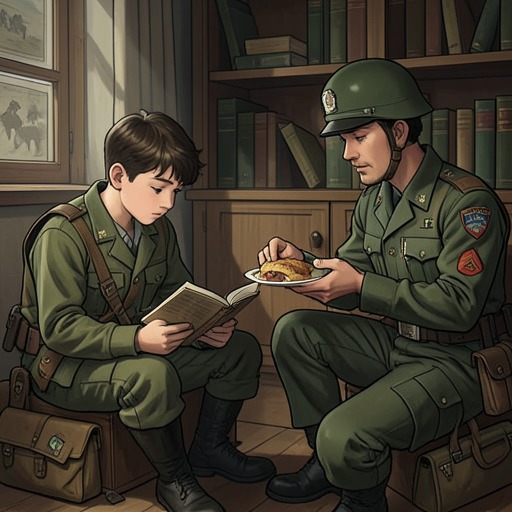
The boy receives this political instruction with intense attention. He writes questions on a slate, listens to the soldiers’ conversations before and after meetings, and eavesdrops on the meetings through the canvas walls of a tent. He tries to memorize Gavrila’s words. Political teaching reaches him not as a detached account of institutions but as a world he is living among, where he can observe the soldiers, their conversations, and the authority attached to membership.
That education offers him a route away from helplessness. Having been repeatedly displaced and treated as an outsider, he is attracted to Gavrila’s assurance that actions matter, that goodness can be promoted through human effort, and that a larger organization can make individual lives useful to others. Yet the same lessons reveal how demanding this belonging would be. A person must keep pace with the working people, neither pushing too far ahead nor lagging behind; a stumble can impede the whole column, and those who fall may be trampled. The marching image turns unity into both solidarity and risk.
The Communist Party’s importance in the narrative lies in this double promise. Through Gavrila’s teaching, it replaces divine providence with historical agency and offers the boy a powerful explanation of how separate lives might form a common design. But the organization’s own methods—evaluation, surveillance, ranked advancement, and collective authority over individual usefulness—complicate the freedom it claims to organize. The boy’s attraction and apprehension coexist: the Party gives him a vocabulary for purpose and a possible place among others, while making him wonder whether that place would be chosen for him.